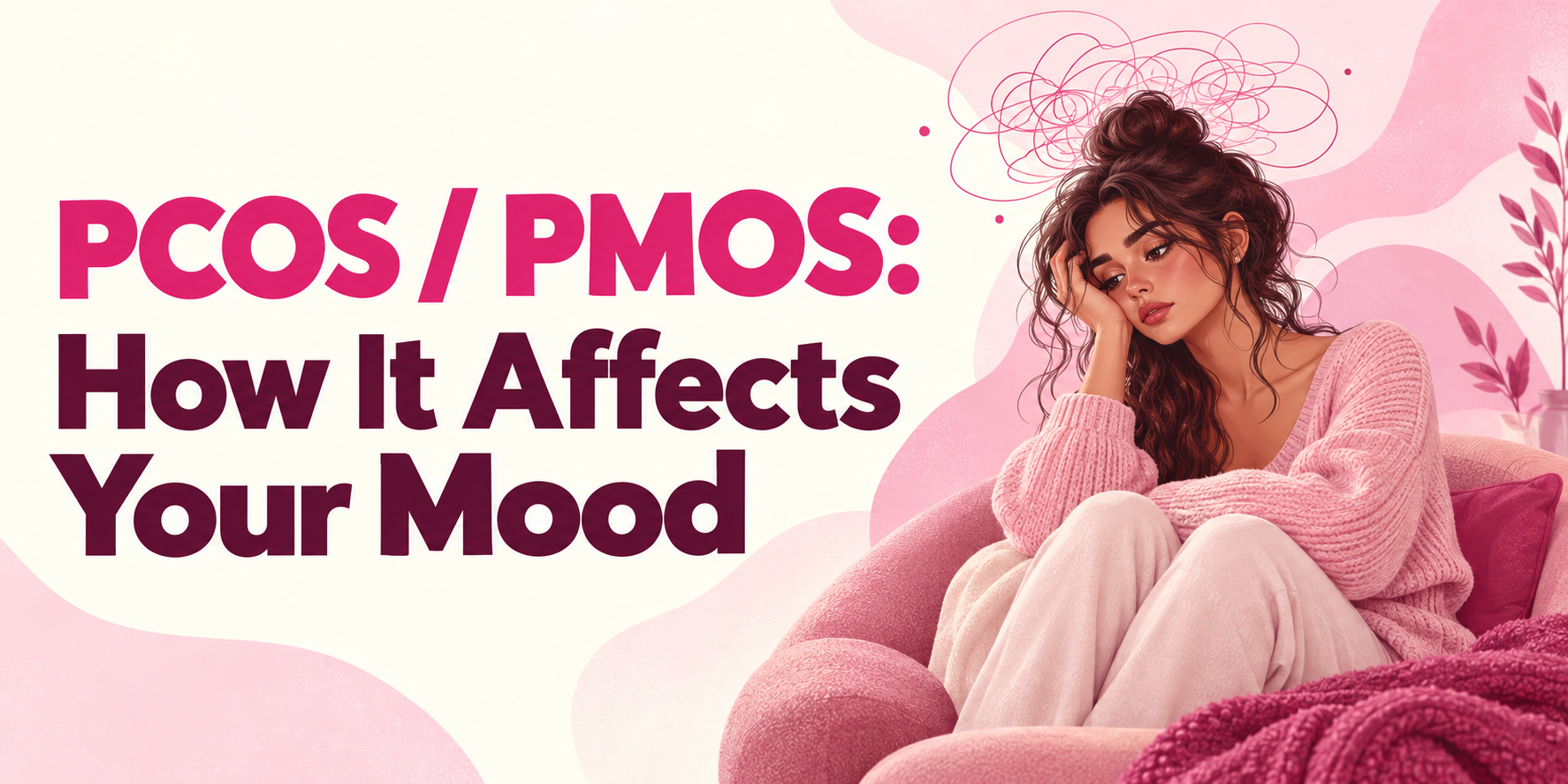
If you live with PCOS, you probably know the physical checklist by heart: irregular periods, stubborn acne, unwanted hair, weight that won't budge, maybe a fertility scare or two. What doesn't make the list nearly as often is how it can make you feel — flat, anxious, foggy, or quietly worn down.
That emotional side is real, it's common, and it's backed by a lot of research. Here's what we know about the link between PCOS/PMOS and depression, why it happens, and the practical steps (including support right here in Singapore) that can make a difference.
✿ Key takeaways
- In May 2026, PCOS was officially renamed PMOS — polyendocrine metabolic ovarian syndrome — to reflect that it's a whole-body condition, mental health included.
- Women with PCOS/PMOS have around 2.6–2.7 times higher odds of depression and anxiety than women without it.
- International guidelines say every adult and teen with PCOS should be screened for depression, and every adult for anxiety.
- Psychological therapy is the recommended first step — and treating the mood often makes managing PMOS itself easier.
First things first: PCOS is now PMOS
"Polycystic ovary syndrome" was always a misleading name. Many people with the condition don't have ovarian cysts at all, and the name made it sound like a purely gynaecological issue.
After more than a decade of debate and input from around 22,000 people worldwide, a global consensus published in The Lancet in May 2026 renamed it polyendocrine metabolic ovarian syndrome (PMOS). The change has since been endorsed by the American Society for Reproductive Medicine. The new name recognises that the condition involves your hormones, your metabolism, your skin, your fertility — and your psychological health.
Good to know: doctors and clinics are still transitioning, so you'll see both "PCOS" and "PMOS" for a while. They describe the same condition. We use both in this article.
How common is depression with PMOS?
More common than most people are told. The numbers vary between studies, but the pattern is consistent:
1 in 8
women worldwide live with PMOS — over 170 million people
~37%
experience depressive symptoms, vs. ~14% of women without it
2.6×
higher odds of depression — and 2.7× for anxiety
Other studies put the figure even higher. A 2026 Australian national study found 47% of women with PMOS reported depression, and a review of 38 studies in lower- and middle-income countries found rates were highest among women aged 20–25.
And here's the frustrating part: experts reviewing the 2023 international guideline noted that this side of the condition is often neglected by healthcare professionals. So if no one has ever asked how you're coping emotionally, you're not alone — but you deserve to be asked.
Why are PMOS and depression linked?
There's no single cause. Researchers think it's a mix of what's happening inside your body and what it's like to live with the condition day to day.
Hormone shifts
Higher androgens (like testosterone), irregular ovulation and changes in the body's stress-hormone system may all influence mood regulation. The "polyendocrine" in PMOS reflects just how many hormones are involved.
Insulin resistance & inflammation
Insulin resistance and low-grade inflammation are common in PMOS. Researchers think both may play a role in depression, though the science is still developing.
Body image
Visible symptoms — acne, hair growth, hair thinning, weight changes — can chip away at confidence and make social situations or intimacy feel stressful.
Fertility worries
Uncertainty about having children — or the pressure of trying — is a heavy emotional load, especially with well-meaning family questions.
Long road to diagnosis
In a survey of 1,385 women, a third waited over two years for a diagnosis, and nearly half saw three or more health professionals. Being dismissed again and again takes a real toll.
Low mood
Low mood makes it harder to sleep, move and eat well — which can worsen PMOS symptoms, which can deepen low mood.
A Singapore note: PMOS is often pictured as a "weight" condition, but a Singapore Medical Journal review points out that most patients with PCOS in Singapore have a normal body weight. That matters for mental health: if you're told "just lose weight" when that isn't your issue, it's easy to feel unheard — and your low mood deserves attention regardless of your size.
Signs it might be more than a bad week
Everyone has down days. It may be worth speaking to someone if several of these have stuck around for two weeks or more:
- ♥Feeling sad, empty or hopeless most of the day
- ♥Losing interest in things you used to enjoy — including sex and intimacy
- ♥Sleeping far more or far less than usual
- ♥Constant tiredness, even after rest
- ♥Trouble concentrating or making decisions
- ♥Harsh self-criticism or feelings of worthlessness
- ♥Pulling away from friends, family or your partner
- ♥Constant worry, restlessness or a racing mind (often signs of anxiety, which frequently travels with depression)
What actually helps
The encouraging news: depression linked to PMOS is very treatable, and you don't have to choose between looking after your hormones and looking after your mind. These steps work best together.
Ask to be screened
The 2023 international guideline recommends screening all adults and adolescents with PCOS for depression, and all adults for anxiety. You can bring it up yourself: "I've been feeling low — could this be connected to my PMOS?"
Start with talk therapy
The guideline recommends psychological therapy as the first-line approach, following the same evidence-based options used for anyone with depression or anxiety — cognitive behavioural therapy (CBT) is a common example.
Treat the PMOS itself
Managing symptoms like acne, unwanted hair or irregular cycles with your doctor can noticeably lift your mood and confidence. If medication for depression is needed, the guideline advises doctors to limit options that worsen PMOS symptoms such as weight gain. It also notes untreated depression can make it harder to stick with PMOS treatment.
Move in ways you enjoy
Regular activity supports insulin sensitivity and mood. Think a walk at the Botanic Gardens, a dance class, a swim — not punishment workouts. Consistency beats intensity.
Protect your sleep
The guideline lists sleep disorders among the conditions linked to PCOS, and poor sleep can weigh on both mood and metabolism. If you snore or wake up exhausted, mention it to your doctor.
Find your people
Talking to others who get it — friends, a partner, or online and local PCOS/PMOS communities — reduces the isolation that feeds depression.
PMOS, mood and your intimate life
This part rarely gets talked about. A review in Fertility and Sterility found good evidence that women with PCOS face a higher risk of body image distress and sexual difficulties, alongside depression and anxiety. Depression itself, and some antidepressants, can dampen desire further.
None of this means something is "wrong" with you. A few gentle ideas:
Take the pressure off. Intimacy doesn't have to mean sex. Cuddling, massage or simply being close counts — and can rebuild connection without expectation.
Talk openly. Telling your partner what you're going through ("I'm not rejecting you — my mood and body are having a hard time") prevents misunderstandings on both sides.
Make comfort a priority. Stress, low mood and some medications can make arousal and natural lubrication harder. A good-quality lubricant can make things more comfortable and less stressful.
Reconnect with yourself first. Solo self-care — a warm bath, a body-positive moment, exploring what feels good at your own pace — can help you feel at home in your body again.
Where to get support in Singapore
Start with your GP or polyclinic — they can screen your mood, review your PMOS management and refer you to a gynaecologist, endocrinologist or mental health professional. Women's health specialists at hospitals such as KK Women's and Children's Hospital also see patients with PCOS/PMOS.
If you'd like to talk to someone now, these services are free or low-cost and confidential:
Frequently asked questions
Can PCOS/PMOS cause depression?
PMOS doesn't automatically cause depression, but it significantly raises the risk. Hormonal and metabolic factors, combined with the stress of living with visible and fertility-related symptoms, all play a part.
Why was PCOS renamed PMOS?
The old name focused on ovarian "cysts", which many people with the condition don't have. PMOS — polyendocrine metabolic ovarian syndrome — better reflects that it affects hormones, metabolism and mental health across the whole body.
Will treating my PMOS improve my mood?
It often helps, especially when distressing symptoms like acne or excess hair improve. But mood deserves its own attention too — therapy and, where appropriate, medication work alongside PMOS treatment, not instead of it.
Can birth control pills affect my mood?
The pill is commonly used to manage PMOS symptoms. A 2026 study of women with PMOS found depression rates were similar in pill users and non-users, though larger studies are still needed. Everyone responds differently — if you notice a mood shift after starting or switching, talk to your doctor rather than stopping on your own.
Is low libido normal with PMOS?
It's common. Hormones, body image, depression and some medications can all affect desire. It's worth raising with your doctor — and with your partner — so you can find solutions together.
You are more than a diagnosis.
Looking after your mind is part of looking after your PMOS. Be gentle with yourself, ask for the support you deserve because eeling better is possible.
Sources
- STAT News — PCOS is now called PMOS (May 2026)
- ASRM — PCOS is Now PMOS: Understanding the Name Change (2026)
- Cooney et al., Human Reproduction (2017) — Depressive and anxiety symptoms in PCOS: meta-analysis
- Forslund et al., Acta Obstet Gynecol Scand — International PCOS guideline, a Nordic perspective
- Recommendations from the 2023 International Evidence-based PCOS Guideline
- Teede et al., Medical Journal of Australia — 2023 guideline summary
- Medical Xpress — Mental health toll of endometriosis and PMOS (Aug 2026)
- Frontiers in Global Women's Health — Depression and anxiety in PCOS in LMICs
- Gibson-Helm et al., J Clin Endocrinol Metab (2017) — Delayed diagnosis in PCOS
- Karampela et al., Clinical Endocrinology (2026) — PCOS and depression
- Fertility and Sterility — Mental health assessment in PCOS management
- Oral contraceptives and depression in PMOS (2026)
- Singapore Medical Journal — Managing PCOS in primary care
- national mindline 1771 · Samaritans of Singapore · AWARE Women's Helpline
This article is for general information only and isn't a substitute for professional medical advice. Please speak to your doctor or a qualified mental health professional about your individual situation.