Sometimes it starts with one painful attempt.
You might tell yourself, “Maybe I was just nervous.” Then you try again, hoping it will be different. You tell yourself to relax. You want your body to cooperate. But the moment penetration is about to happen, your whole body seems to tighten before you can even think about it.
After a while, the question becomes bigger than sex.
You may start wondering:
Why can’t my body just work normally? What is wrong with me?
I have met women who feel deeply embarrassed by this. Some compare themselves to friends, to people online, even to teenagers who seem to get pregnant by accident, and think, “They can do this so easily. Why can’t I?”
One woman I worked with had been married for four years. She and her husband had both been virgins before marriage, and they hoped to have a child. But they had not been able to consummate their marriage.
She loved her husband. She wanted to be close to him. She wanted her body to “just accept” penetration. But after a few painful attempts, the thought of trying again had become frightening.
That is often what people do not see about vaginismus. It is not only about penetration being difficult. It can slowly affect your confidence, your relationship with your body, your desire for intimacy, and the way you see yourself as a woman.
What is vaginismus?
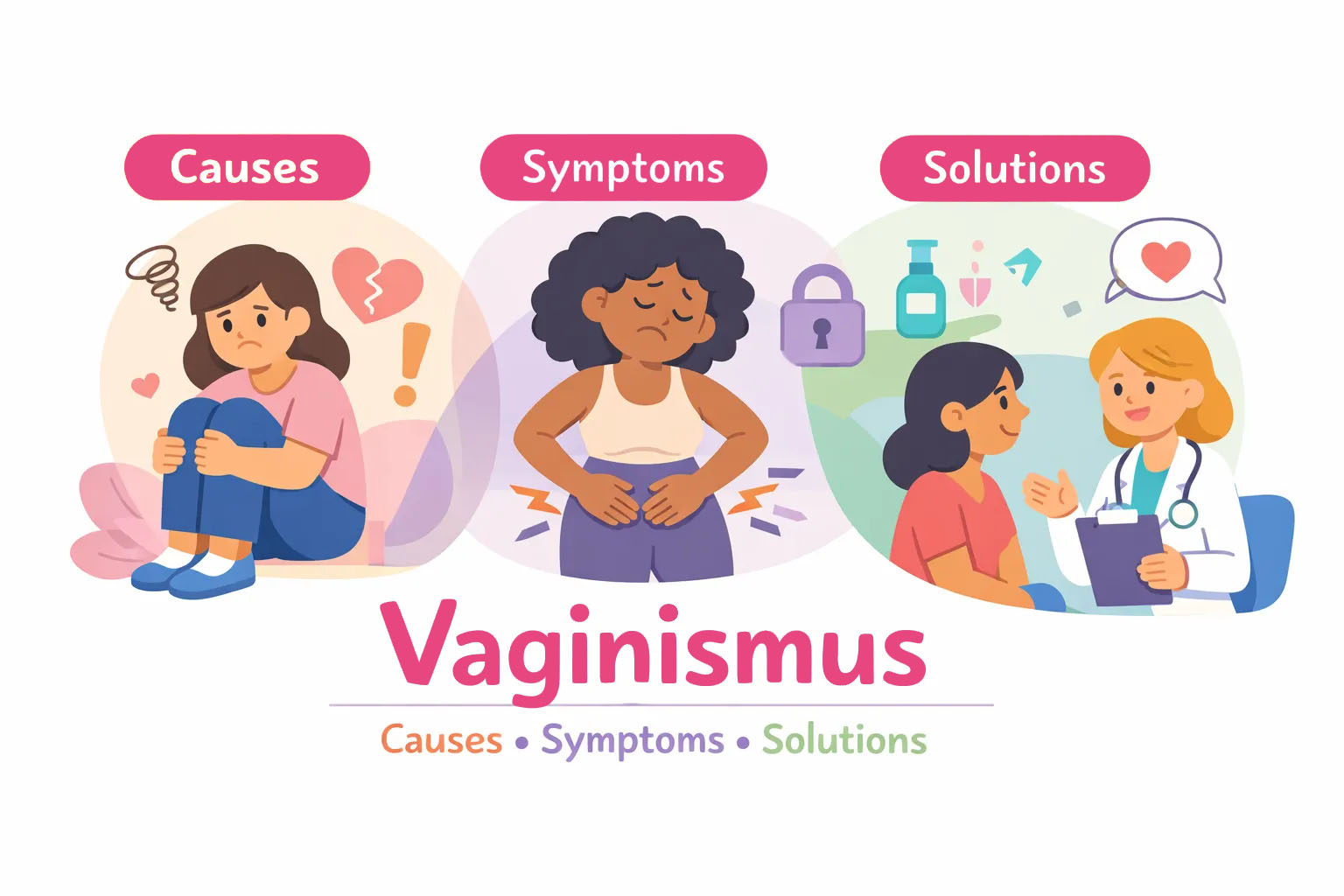
Vaginismus is when the muscles around the vaginal opening tighten automatically when penetration is attempted. This can make sex painful, difficult, or sometimes impossible. Some women may also find it difficult to insert a tampon, a finger, or undergo a gynaecological examination.
The important thing to understand is that this tightening is not deliberate.
You may want intimacy. You may feel attracted to your partner. You may even feel mentally ready. But your body may still brace itself before penetration happens.
This is why “just relax” is usually not helpful advice. When the body has started linking penetration with pain, fear, pressure, or uncertainty, relaxing is not always something you can simply decide to do.
Also, not every painful sexual experience is vaginismus. Pain can happen for many reasons, including dryness, infections, skin conditions, hormonal changes, endometriosis, pelvic-floor tension, or other medical concerns. So rather than guessing or blaming yourself, it is worth getting properly assessed.
The emotional part that many women carry quietly
- For many women, the pain is only one part of the experience.
- There can be shame: “Why can everyone else do this, but I can’t?”
- There can be guilt: “Am I disappointing my partner?”
- There can be frustration: “I am trying so hard. Why is my body not listening to me?”
And over time, there can be self-blame. Some women start to believe they are broken, too tense, too fearful, too inexperienced, or somehow less feminine because penetration is difficult.
Then again, the more you blame yourself, the harder it becomes to feel safe in your own body.
Some women tell me that they stop initiating intimacy altogether. They may avoid kissing, cuddling, or sexual touch—not because they do not want closeness, but because they are already worried about what might happen next.
They do not want another painful attempt. They do not want to disappoint their partner. They do not want to feel like they have “failed” again.
From the outside, this can look like low desire. But sometimes it is not that desire has disappeared. Sometimes it is just that fear has become louder.
When vaginismus starts affecting the relationship
Vaginismus can affect both people in a relationship, but it is important not to turn it into a question of who has failed whom.
A woman may feel responsible for her partner’s unmet needs. Her partner may feel confused, helpless, rejected, or worried about causing pain. Both people may avoid talking about it because they do not want to upset the other person.
Over time, the relationship can become very focused on one question: “Will sex work this time?”
That kind of pressure can make intimacy feel like an exam that must be passed.
For couples who are trying to conceive, the pressure can become even heavier. Sex may start to feel like a task, a duty, or a reminder of something that is not working.
But intimacy is bigger than intercourse.
Kissing, affection, touch, pleasure, laughter, safety, and being able to speak honestly with each other all still matter. Intercourse should not become the only measure of whether a relationship is loving, sexual, or successful.
Your body is not broken
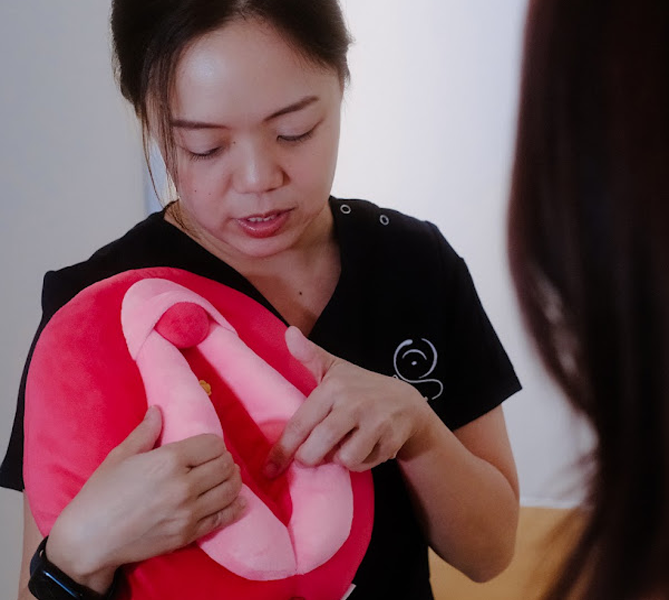
I often explain pelvic-floor awareness using the muscles around our eyebrows.
Most of us know that our eyebrows can move. But not everyone can move one eyebrow independently on command. It is not because their face is broken. It is simply because they may not have the awareness or practice yet.
Pelvic-floor muscles can be a little like that. Many women have never been taught how to notice when these muscles are tightening, how to release them, or how to feel safe enough in their body to allow movement around them. That said, vaginismus is not simply a “muscle-control problem”. It is also not about being weak or failing to relax properly.
For some women, pain, fear, cultural messages about sex, relationship pressure, lack of sexual education, past experiences, or other physical issues may all be part of the picture. Sometimes, there is no single clear reason. The woman I mentioned earlier had grown up believing that first-time sex was supposed to be painful. So when it hurt, part of her thought she simply had to endure it.
A major shift for her was realising that pain was not something she had to push through. Sex does not need to be perfect, and it does not need to be instantly pleasurable every time. But it should not feel like something your body has to survive.
What support can look like
Support looks different for different women.
A medical assessment can help rule out other reasons for pain. Pelvic-floor physiotherapy can help with body awareness, muscle feedback, relaxation, and control. Psychosexual therapy or counselling can help address fear, shame, pressure, and the messages you may have learned about sex while growing up.
For some women, gradual desensitisation or vaginal dilators may be part of the process. But this is not about forcing yourself, pushing through pain, or trying to “pass” penetration.
The aim is to help your body slowly learn that it can be safe.
Partner education can be helpful too. Sometimes couples need to relearn how to move from affection and touch towards intimacy, without making penetration the final goal every time. Lubricant may improve comfort in some situations, but it is not a standalone solution for vaginismus.
Progress may look small in the beginning.
Maybe you feel less afraid when something comes near your genitals. Maybe you notice that you are not bracing as much. Maybe you can stay present instead of panicking. Maybe you start feeling curious about intimacy again.
Those are not small things. They are signs that trust in your body is starting to come back.
If pain, fear, or avoidance has quietly become part of your intimate life, you do not need to keep carrying it alone. With the right assessment and support, it is possible to build comfort, confidence, and connection again—at a pace that feels manageable for you.
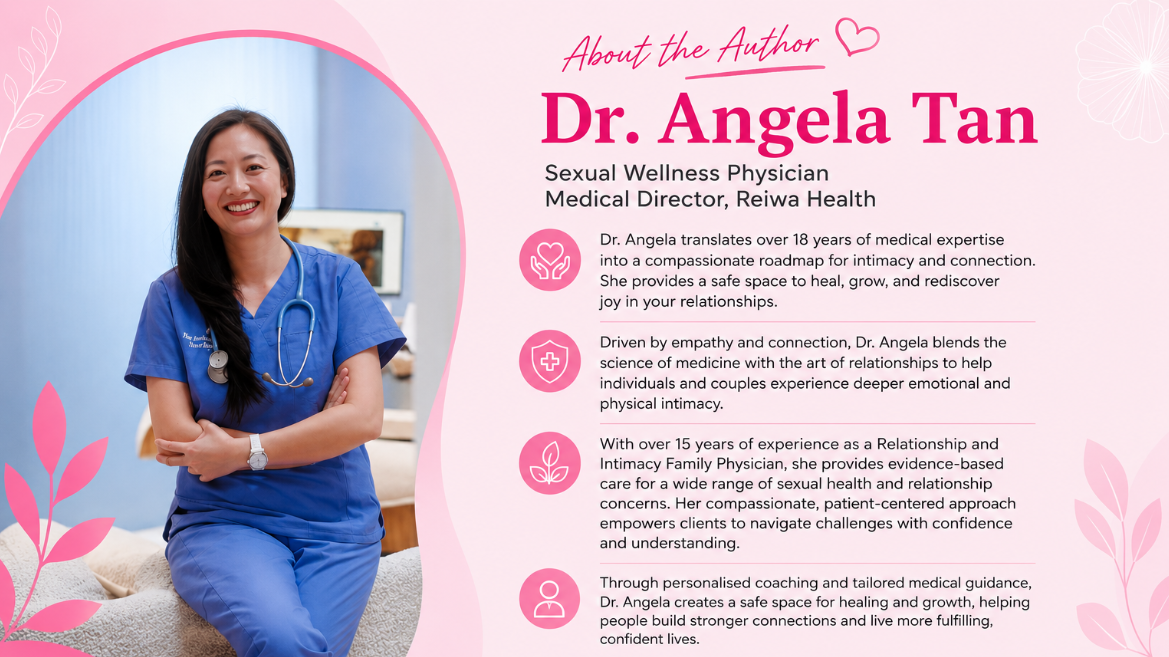
Dr. Angela Tan is a Sexual Wellness Physician and the Medical Director of Reiwa Health. Seamlessly blending medical science with the art of relationships, she translates over 18 years of clinical expertise into a compassionate roadmap for deeper emotional and physical intimacy. Through evidence-based care and personalized coaching, she creates a safe, empowering space for individuals and couples to heal and grow.