"I am tired of begging for sex. If she wants it, she needs to initiate."
"I avoid hugging him sometimes. I know where it is going to lead."
"I still have desire, just not for my partner anymore."
These are things I hear from couples in my consultation room. By the time they come in, many have already decided what the problem is: she has low libido, he doesn't desire me anymore, we're sexually incompatible.
Maybe. But before I accept that diagnosis, I ask one question first: what has led us here? Because when sex disappears from a relationship, desire is usually only one part of the story. Here are the questions I get asked most, answered the way I'd answer them in my clinic.
Is it really low libido, or something else going on?
Not always — and this is the first thing I untangle. Low libido, desire discrepancy, sexual avoidance and sexual dysfunction get talked about as if they're the same thing. They're not.
Someone may have generally low desire and rarely think about sex at all. Someone else may still fantasise, masturbate, or feel attracted to other people, yet have little desire for their partner specifically. Another person still wants their partner, but sex itself has become difficult — it hurts, the erection is unreliable, orgasm takes too much work, or it's just become repetitive. And sometimes two people simply want different amounts of sex: one wants it twice a week, the other is happy with once a month. Neither of them necessarily "has a problem."
Before I try to increase anyone's libido, I need to know which of these is actually happening.
Isn't desire supposed to just happen on its own?
We carry this idea that desire should be spontaneous — you feel horny, you want your partner, you have sex. Sometimes it does work exactly like that.
For other people, desire is responsive. They don't start out feeling sexual; something happens first — touch, flirting, closeness — and desire follows. This matters a lot in long-term relationships. After children, work, bills and caregiving, you may not spontaneously feel aroused at 10pm. But there still needs to be something worth responding to. If sex has become painful, pressured, rushed or disappointing, telling someone to "just get started" isn't really an answer.
Why do people start avoiding sex instead of talking about it?
Because avoiding it is often easier than explaining what's actually going wrong — and this happens to both men and women.
A man may be worrying about whether his erection will hold, or that he finishes too quickly. He might be embarrassed about how his penis looks, or sitting on a sexual interest he's never told his partner about because he's afraid of being judged. A woman may be dealing with pain, dryness, pelvic-floor tightening, or the sheer effort of getting aroused — she may already be calculating whether she can orgasm before anything has even started.
For either partner, avoidance can feel safer than saying any of that out loud. But the partner on the receiving end usually reads it as "you don't want me anymore" — and once that assumption sets in, every encounter starts to feel like a test nobody can pass.
Is the sex itself part of the problem?
Very often, yes — and this is the question I think gets skipped the most. We have this fantasy that sex should be easy and exciting, something you jump into without a second thought. We don't talk enough about how much quiet work it can take to actually get there.
Take orgasm. For some women, even thinking about the effort involved is exhausting — am I turned on enough, why is this taking so long, is he getting tired, why can't I relax. The harder she tries, the more pressure she puts on herself, until "if I have to work this hard every time, I don't even feel like starting" becomes the honest thought. Men carry their own version of it: will I get hard, will I stay hard, am I lasting long enough. There isn't much room left for pleasure when your brain is busy scoring your own performance.
So instead of only asking "why is my libido so low," I ask couples: does the sex actually feel good? Does anything hurt? Is penetration always the main event? Do you know what genuinely gives each other pleasure? And the one I think matters most — would you honestly look forward to the sex you're having?
Why does rejection in the bedroom start affecting the rest of the relationship?
Rejection in relationships often goes beyond sex. When one partner continually says no to intimacy, feelings of frustration can arise, leading to statements like, "I’m tired of begging for sex; she should initiate."
This dynamic then affects other forms of affection. One partner may feel rejected when their attempts at physical closeness are pushed away, while the other avoids affection for fear of it leading to unwanted sex. As a result, even simple hugs become tense, with one partner thinking they can’t touch the other, and the other fearing they’ll have to say no again. Ultimately, sexual intimacy declines first, followed by a loss of ordinary affection.after.
Why shouldn't we treat erections, wetness or orgasm as proof of love?
Because they aren't reliable proof of anything. Couples turn what happens during sex into evidence: no erection means "I'm not attractive enough," no lubrication means "I'm not pleasuring her enough," no orgasm means "something is wrong with me," no initiation means "I'm not desired."
These conclusions grow far bigger than the original physical issue. An erection can fail even when attraction is genuinely strong. A woman can be very attracted to her partner and still experience dryness or pain. Someone can love their partner deeply and still have very little desire for them. Our sexual response is simply not a trustworthy measure of how much we love someone — and I try to get couples to stop using it as one.
Where should a couple actually start?
Not with the scorecard. By the time some couples reach me, they can tell me exactly how many times they had sex last year, who initiated, who rejected whom, how many weeks it's been. I'm much less interested in the tally — I want to know how they got there. So I start with five questions:
- What's happening in my body? Pain, dryness, erections, ejaculation, hormones, medication, sleep, energy — has something physically changed?
- What's happening to my desire? Is it low everywhere, or do I still fantasise or feel desire elsewhere — just not for my partner?
- What does sex feel like now? Pleasurable, painful, pressured, predictable — something I look forward to, or something I get through?
- What has happened to the relationship? What's accumulated between us — rejection, resentment, broken trust, pressure?
- What else is happening in our lives? Children, work, money, caregiving, poor sleep, no privacy, no time.
Sometimes it isn't only the sex that's disappeared. The couple has disappeared too.
When should a couple get professional help?
If this has been going on for months and you're both getting more frustrated, avoiding each other, or replaying the same argument, it's probably time to stop trying to work through it alone.
Get help sooner if there's pain, a persistent erection or ejaculation difficulty, a sudden change in desire, orgasm difficulty that's causing real distress, significant hormonal or menopausal symptoms, or if sex has become something one of you actively dreads. You don't have to wait until things are in crisis — some couples only come in after years of resentment and scorekeeping, and by then we're no longer dealing with libido alone.
Low libido is real, and it sometimes needs proper medical assessment. But counting how often you have sex won't tell you why you ended up here. Start with the same question I always ask first: what has led us here?
Pain or dryness during sex is one of the most common — and most fixable — starting points. A good lubricant or an arousal gel like the Shunga Secret Garden Clitoral Arousal Gel can lower the physical barrier while you work through the rest with your partner or a specialist.
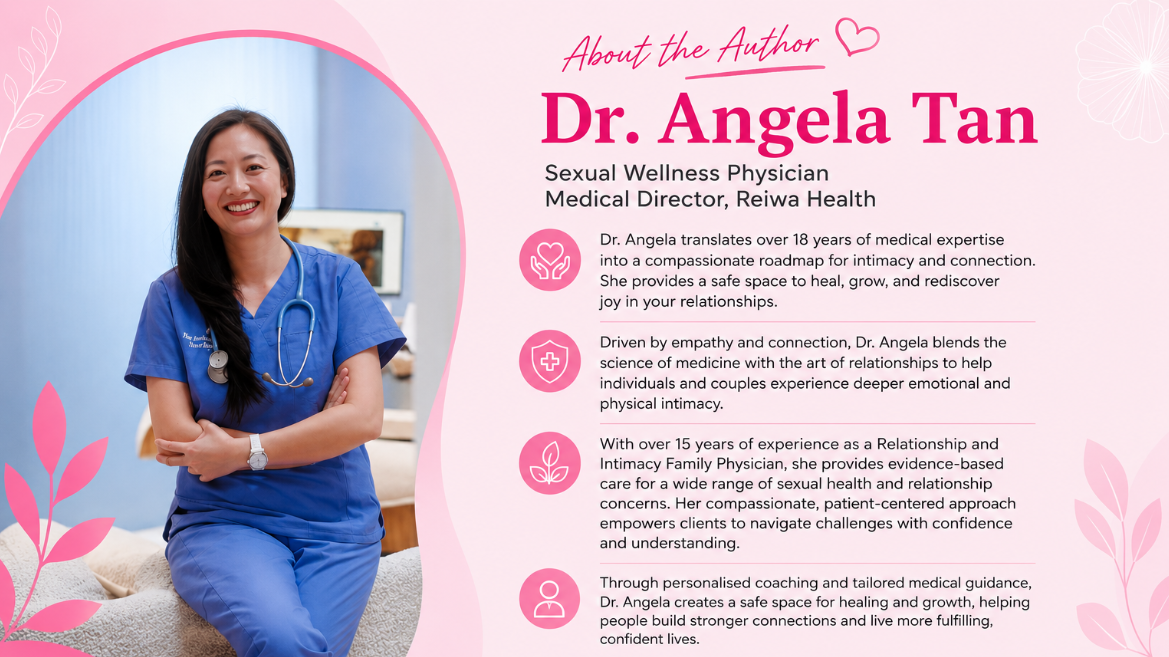
Dr. Angela Tan is a Sexual Wellness Physician and the Medical Director of Reiwa Health. Seamlessly blending medical science with the art of relationships, she translates over 18 years of clinical expertise into a compassionate roadmap for deeper emotional and physical intimacy. Through evidence-based care and personalized coaching, she creates a safe, empowering space for individuals and couples to heal and grow.